Introduction
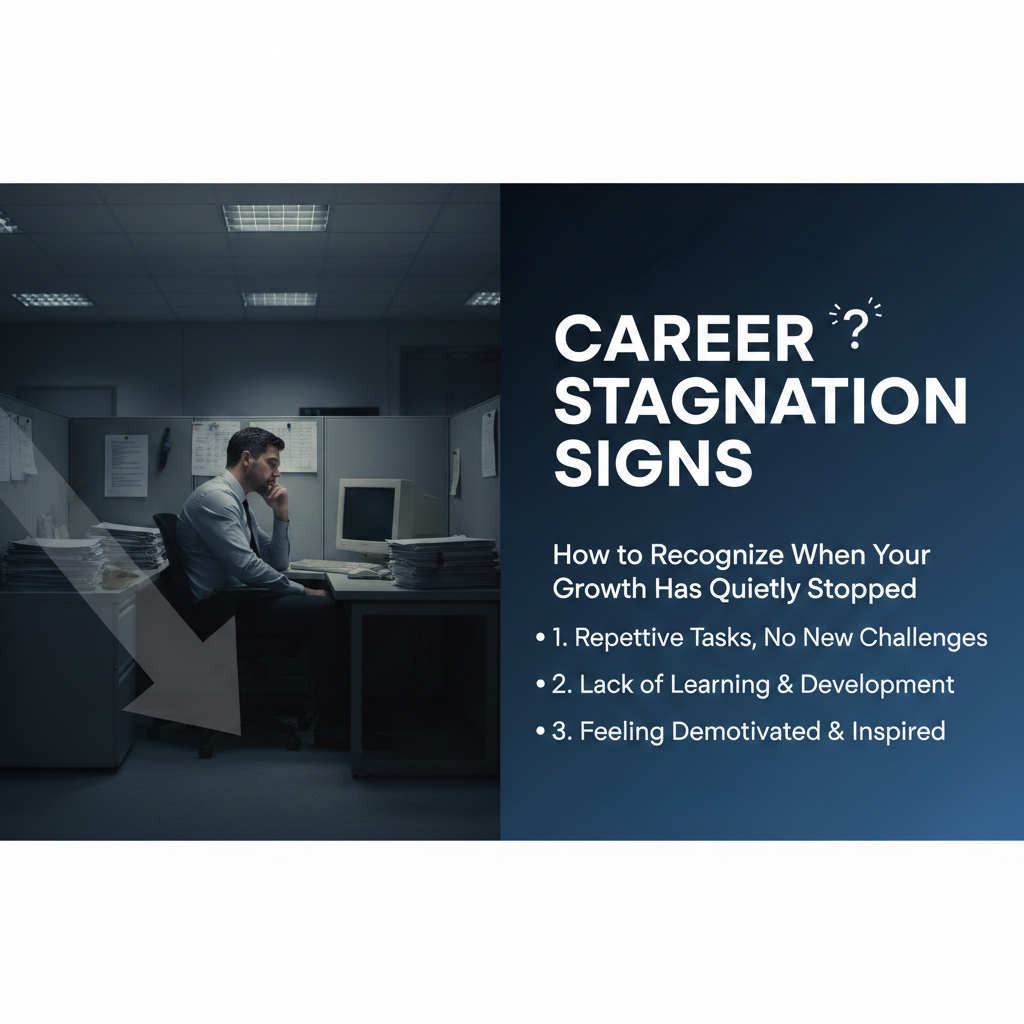
Career Stagnation Signs rarely begins with dissatisfaction or declining performance. More often, it emerges quietly — through slower learning, reduced exposure to decisions, or repetitive work that no longer stretches capability. On the surface, it may look like stability, comfort, or routine. Beneath the surface, however, growth has stalled.
Many professionals assume stagnation only means boredom or lack of promotion. In reality, it is often more subtle: your role continues to function, your results remain steady — but your value is no longer expanding.
This article explores the less obvious signs of career stagnation, how to distinguish a temporary plateau from a deeper structural limit, and how experienced professionals decide when to redesign a role, remain temporarily, or prepare for a strategic transition.
Career Stagnation Signs: How to Recognize When Growth Has Quietly Stopped
Career stagnation does not always reflect poor performance. In many situations, individuals continue delivering strong outcomes — but their learning curve has flattened and their influence has narrowed.
Modern stagnation often involves:
Solving the same types of problems repeatedly
Limited exposure to new or strategic decisions
Skills being applied — but no longer stretched
Professionals remain competent and effective… yet they are no longer developing.
Early Signals Your Career May Be Stagnating
1) Learning Has Noticeably Slowed
You are capable and confident in your work — but rarely challenged.
New tasks feel familiar rather than demanding new thinking.
Growth hasn’t stopped because of failure —
it stopped because the learning environment no longer evolves.
2) Your Role Has a Fixed — and Unmoving — Ceiling
You clearly understand the limits of your responsibilities.
Those boundaries have not shifted in a long time.
Growth feels possible in theory, but inaccessible in practice.
3) Your Influence Is Quietly Shrinking
You still execute decisions —
but you’re less involved in shaping them.
Influence rarely disappears suddenly.
It fades gradually — and often goes unnoticed at first.
4) Feedback Has Become Predictable
Performance reviews sound positive, but repetitive:
reliable
consistent
dependable contributor
However, they lack direction toward:
broader scope
strategic responsibilities
stretch assignments
Predictable praise is one of the strongest stagnation indicators.
Healthy Plateau vs Career Stagnation
| Signal | Healthy Plateau | Career Stagnation |
| Learning pace | Temporarily slower | Persistently flat |
| Role scope | Stable but flexible | Fixed and narrow |
| Influence | Sustained | Gradually reduced |
| Energy | Calm & focused | Mentally disengaged |
| Future options | Still visible | Hard to imagine |
A plateau can be healthy.
Stagnation persists unless intentionally addressed.
Why Career Stagnation Happens
Stagnation is rarely about motivation or effort.
Common causes include:
organizational ceilings
comfort zones that slowly harden
misalignment between strengths and role design
reliance on past success instead of evolving capability
In many careers, stagnation is simply success without evolution.
Common Mistakes People Make When They Feel Stuck
Mistake 1 — Making Immediate “Escape” Decisions
Quitting impulsively — without diagnosis — often recreates the same conditions elsewhere.
Better approach: understand the structural cause before moving.
Mistake 2 — Placing Full Responsibility on the Employer
Organizations influence growth — but positioning also matters.
Better approach: separate systemic limits from personal leverage.
Not all stagnation requires exit.
Some roles require redesign.
When Stagnation Can Be Strategic — Temporarily
Stagnation is often framed as negative — but in some career cycles, it is intentional:
stabilizing income
restoring energy
preparing for a major transition
The risk is not temporary stagnation —
it is unconscious stagnation.
Real-World Scenario
A senior professional remains in a stable role for two years:
minimal learning
predictable workload
But uses the period to:
build adjacent skills
strengthen external networks
design a calculated career pivot
What appeared stagnant became strategic repositioning.
How to Respond When You Recognize These Signs
Ask yourself three clarity questions:
Can I reshape this role within the next six months?
Can I access new challenges or decision exposure?
Are the skills I am developing still transferable?
If the answers lean toward no, the stagnation is likely structural — not temporary.
Suggested YouTube Reference
“How to Know If You’re Stuck in Your Career”
(Choose a reflective, strategy-oriented leadership or career psychology channel.)
FAQs
Is career stagnation always negative?
No — it can be temporary, strategic, or intentional.
How long is “too long” to stagnate?
When learning and influence remain flat for 12+ months.
Can stagnation occur even with strong compensation?
Yes — pay can mask capability decline.
Should I discuss stagnation with my manager?
Often yes — if framed around role evolution and value.
Can stagnation be reversed without quitting?
In many cases — through role redesign or new responsibilities.
Conclusion
Career stagnation isn’t always visible — and it isn’t always failure.
Professionals who recognize the signals early can decide whether to:
redesign their current role
remain temporarily for strategic reasons
or plan a deliberate transition
The greatest risk is not stagnation itself —
but continuing forward without awareness or strategy.
Internal link:
Career Growth Strategies for Professionals: How to Grow Without Waiting for Promotions
External link: Education and career