Introduction
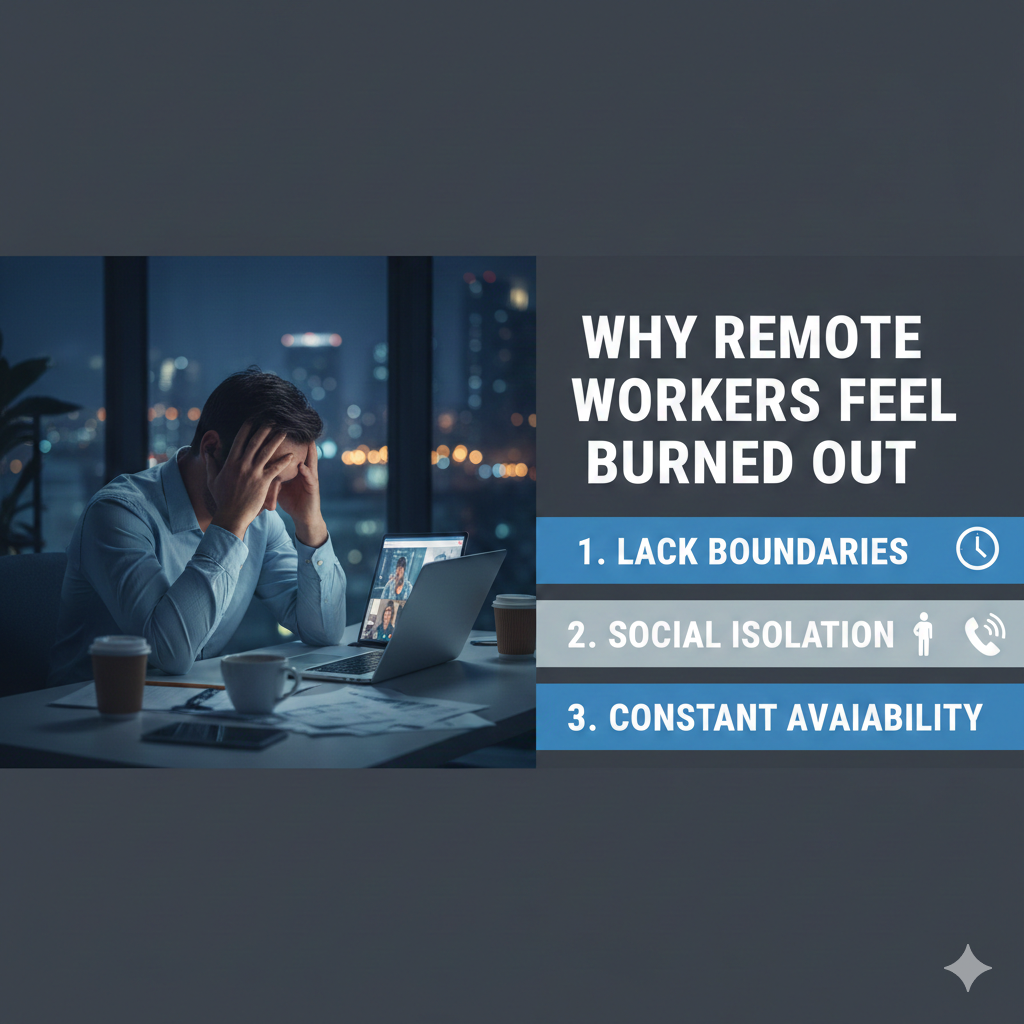
Remote workers feel burned out not because they work from home, but because boundaries blur, expectations stay unclear, and recovery time disappears. Burnout grows when flexibility exists without structure.
At first, remote work feels freeing. Over time, many professionals notice longer hours, constant availability, and a sense that work never truly ends. Unlike office burnout, remote burnout can be quieter and harder to recognize. This article explains why remote workers feel burned out, the hidden drivers behind it, and what actually helps people recover—based on real remote work patterns, not surface-level advice.
What Remote Burnout Looks Like (Beyond Tiredness)
Remote burnout rarely starts as exhaustion. It often shows up as:
Difficulty switching off after work
Reduced motivation despite stable workload
Constant mental fatigue
Feeling “always behind”
Because work happens in personal spaces, recovery signals become weaker.
The Main Reasons Remote Workers Burn Out
- Blurred Work–Life Boundaries
Without physical separation, work expands into personal time.
Common signs:
Checking messages late at night
Working “just a little longer” every day
Guilt when offline
Over time, this erodes recovery.
- Always-On Communication Pressure
Chat tools create the illusion that everyone must be available.
This leads to:
Frequent context switching
Shallow focus
Elevated stress
Being reachable becomes mistaken for being productive.
- Unclear Expectations
When goals aren’t clear, people compensate by working more.
From real remote teams:
Ambiguity increases effort, not results
Overwork replaces clarity
- Invisible Workload
Remote workers often carry hidden effort:
Mental load
Emotional labor
Unseen coordination
Without visibility, effort escalates quietly.
Table: Office Burnout vs Remote Burnout
| Burnout Factor | Office Work | Remote Work |
| Boundaries | Physical separation | Blurred or absent |
| Visibility | Seen by others | Often invisible |
| Recovery | Commute & breaks | Rarely intentional |
| Overwork signal | Overtime | Always-on presence |
| Intervention | Manager notice | Self-diagnosed |
This explains why remote burnout often goes unnoticed longer.
Common Mistakes Remote Workers Make
Mistake 1: Self-Managing Without Limits
High performers often absorb ambiguity by working more.
Fix: Replace effort with clearer agreements.
Mistake 2: Treating Flexibility as Infinite
Flexibility without boundaries becomes pressure.
Fix: Define working hours and protect them.
Expert Warning
Burnout accelerates when people feel responsible for fixing unclear systems alone.
Information Gain: Remote Burnout Is a Systems Failure
Most SERP articles frame burnout as a personal resilience issue.
What they miss is system design.
From practical observation:
Clear priorities reduce burnout more than wellness programs
Fewer meetings often restore energy faster than time off
Burnout decreases when decision ownership is explicit
Remote burnout reflects work design gaps, not individual weakness.
Real-World Scenario (Unique Section)
A remote team experiences rising burnout.
Instead of offering wellness sessions, they:
Reduce meetings by 30%
Define weekly outcomes clearly
Set response-time expectations
Burnout symptoms decline—not because people worked less, but because work became predictable.
What Actually Helps Remote Workers Recover
Effective recovery strategies include:
Clear shutdown rituals
Async-first communication norms
Written priorities
Protected focus blocks
Regular workload reviews
For broader context, see:
Remote Work Challenges and Practical Solutions
Productivity Myths About Remote Work
Embedded YouTube Video (Contextual)
Suggested YouTube Embed:
“Remote Work Burnout Explained (And How to Prevent It)”
(Choose a workplace psychology or organizational health channel—not hustle content.)
FAQs
Why do remote workers burn out faster?
Because boundaries and recovery signals are weaker.
Is remote burnout different from office burnout?
Yes—it’s quieter and often invisible.
Do flexible hours reduce burnout?
Only when paired with clear limits.
Can burnout happen with reasonable workloads?
Yes, when expectations are unclear.
How can managers reduce remote burnout?
By improving clarity, not surveillance.
Conclusion
Remote workers feel burned out when flexibility replaces structure and clarity disappears. Burnout isn’t caused by remote work itself—it’s caused by systems that rely on constant availability and invisible effort. When teams design work intentionally, remote work becomes sustainable instead of exhausting.
internal link:
Remote Work Sustainable Long Term: How to Make It Last 2026
External link:
How to identify skill gaps in the workplace (with tips) | Indeed.com UK