
Introduction
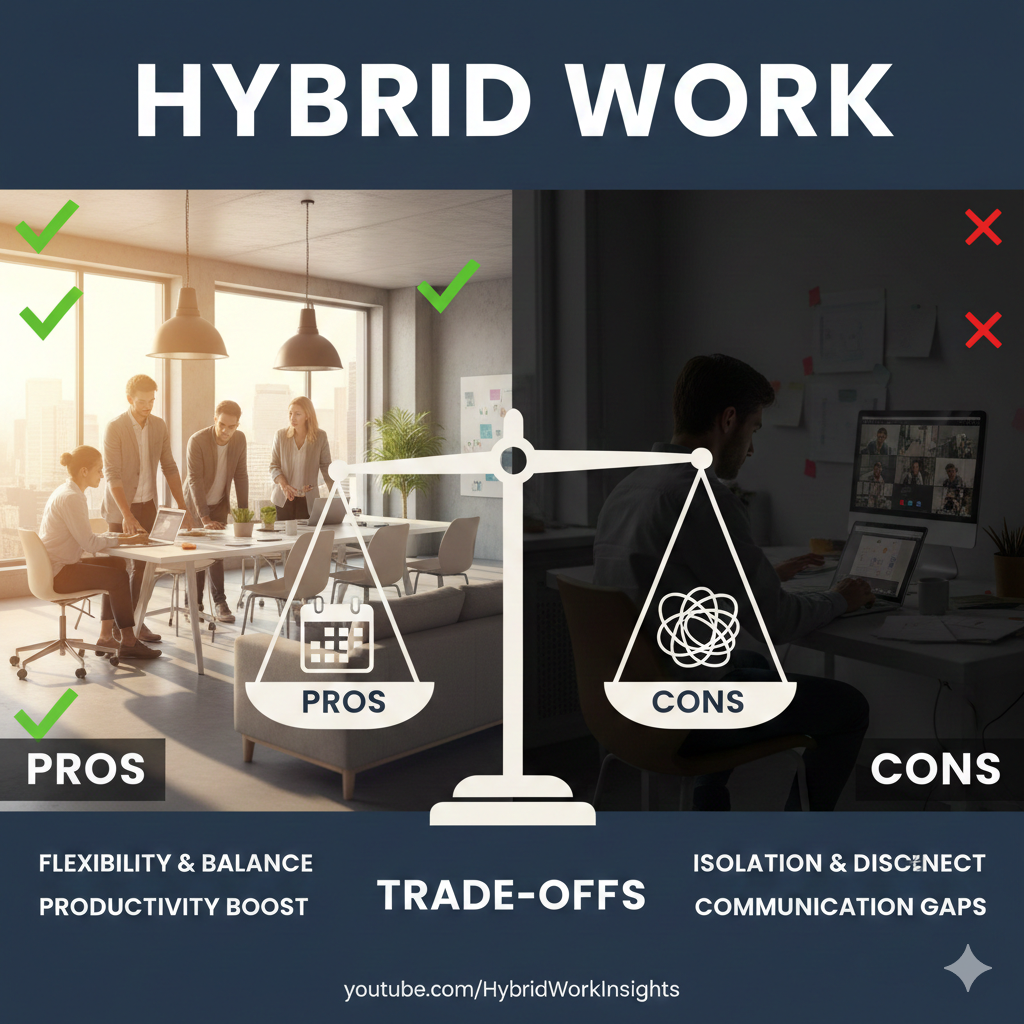
Hybrid Work Pros and Cons combines remote and in-office work, offering flexibility while introducing new coordination challenges. Its success depends less on policy and more on how teams manage clarity, fairness, and communication.
Many organizations adopt hybrid work hoping to get “the best of both worlds.” In practice, hybrid models can amplify confusion if expectations aren’t clear. Some employees feel empowered, while others feel disadvantaged or disconnected. This article explains the real pros and cons of hybrid work, the trade-offs most companies underestimate, and how professionals experience hybrid setups day to day.
What Hybrid Work Actually Means in Practice
Hybrid work isn’t one model—it’s many.
Common variations include:
Fixed office days
Role-based flexibility
Manager-decided schedules
Employee-chosen attendance
Each version creates different outcomes. Problems often arise when hybrid rules are unclear or inconsistently applied.
The Real Pros of Hybrid Work
- Flexibility With Structure
Hybrid work allows flexibility without fully removing in-person collaboration.
Many professionals value:
Fewer commutes
Better energy management
Face-to-face time for complex work
- Better Use of Office Time
When office days are intentional, they’re often used for:
Collaboration
Planning
Relationship building
This can make in-office time more meaningful than daily attendance.
- Broader Talent Access
Hybrid models expand hiring options while still supporting team cohesion.
The Cons of Hybrid Work (Often Overlooked)
- Inequality Between Roles
Not all roles can be equally hybrid.
This creates:
Visibility gaps
Resentment
Perceived unfairness
- Coordination Overhead
Hybrid teams require more planning.
Without care:
Meetings multiply
Decisions slow down
Communication becomes fragmented
- “Second-Class” Remote Days
Employees sometimes feel:
Less heard when remote
Excluded from informal decisions
Penalized for flexibility
These issues quietly erode trust.
Table: Hybrid Work Benefits vs Trade-Offs
| Aspect | Benefit | Trade-Off |
| Flexibility | Better work-life balance | Schedule complexity |
| Collaboration | Intentional in-person time | Meeting overload |
| Talent access | Wider hiring pool | Coordination challenges |
| Office use | More purposeful | Less spontaneity |
| Autonomy | Employee control | Perceived inequity |
This table reflects real hybrid environments—not idealized models.
Why Hybrid Work Feels Harder Than Fully Remote
From practical observation, hybrid work is often harder to manage than full remote or full office setups.
Why?
Two modes must be supported equally
Informal advantages skew toward in-office workers
Policies are interpreted differently across teams
Hybrid work fails when it assumes fairness will happen automatically.
Common Hybrid Work Mistakes (And Fixes)
Mistake 1: Letting Culture Form Accidentally
Unspoken norms favor those physically present.
Fix: Make decisions, expectations, and recognition explicit.
Mistake 2: Measuring Commitment by Attendance
Presence becomes a proxy for performance.
Fix: Evaluate outcomes, not location.
Expert Warning
Hybrid work breaks down fastest when proximity becomes power.
Information Gain: Hybrid Work Is a Management Skill Test
Most SERP articles focus on employee preference.
What they miss is management capability.
From real hybrid teams:
Strong managers create fairness
Weak managers amplify inequality
Hybrid work exposes leadership gaps quickly
Hybrid models don’t fail randomly—they fail predictably when systems are weak.
Real-World Scenario
A hybrid team struggles with missed decisions.
They fix it by:
Writing all decisions in shared docs
Making meetings hybrid-first
Rotating in-office days
Trust improves—not because people came in more, but because information became accessible.
How Professionals Can Thrive in Hybrid Work
Professionals can protect themselves by:
Making contributions visible
Communicating proactively
Attending key in-person moments intentionally
Avoiding “out of sight” drift
For broader context, see:
Remote Work Challenges and Practical Solutions
How Work Culture Is Changing
Embedded YouTube Video (Contextual)
Suggested YouTube Embed:
“Hybrid Work Explained: What Actually Works”
(Choose a leadership or workplace strategy channel—not opinion-only content.)
FAQs
What are the pros and cons of hybrid work?
Flexibility and balance versus coordination and fairness challenges.
Is hybrid work better than remote work?
It depends on management quality and role design.
Why do hybrid teams struggle?
Unclear expectations and unequal access to information.
Does hybrid work hurt career growth?
Only if visibility and communication are unmanaged.
Can hybrid work be fair?
Yes, with intentional systems and leadership.
Conclusion
Hybrid work offers real benefits—but it also introduces trade-offs many organizations underestimate. Flexibility alone isn’t enough. Successful hybrid work depends on clarity, fairness, and strong management systems. When done well, hybrid models combine autonomy with collaboration. When done poorly, they amplify inequality and confusion.
Internal Link:
How Work Culture Is Changing
External Link:
Harvard Business Review – Ideas and Advice for Leaders


