Introduction
Remote work productivity Myths is often judged by outdated assumptions rather than real outcomes. The biggest myths about remote work focus on visibility, hours, and control—yet productivity depends far more on clarity, systems, and energy management.
Since remote work became widespread, debates about productivity have intensified. Some believe people work less at home; others assume productivity automatically increases. In reality, both views miss the point. This article breaks down the most common productivity myths about remote work, explains why they persist, and shows what actually improves results in distributed teams—based on how work functions day to day.
Why Productivity Gets Misjudged in Remote Work
Productivity myths thrive because inputs are easier to observe than outputs.
In offices, managers relied on:
Physical presence
Visible activity
Immediate responsiveness
Remote work removes these signals, forcing organizations to confront a harder question: What does productivity actually mean? When that question isn’t answered clearly, myths fill the gap.
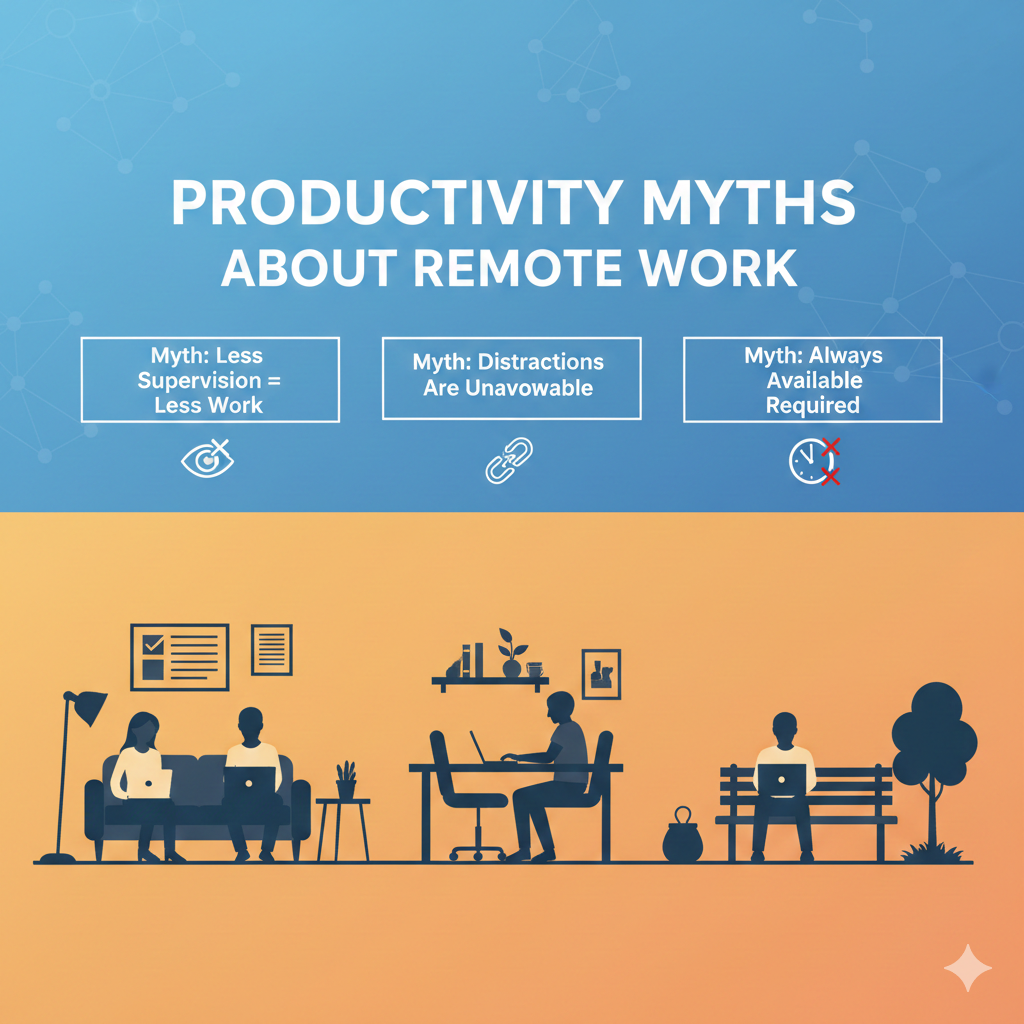
Myth 1: Remote Workers Are Less Productive
This myth assumes productivity comes from supervision.
In practice:
Poorly designed roles underperform anywhere
Clear goals outperform location
Remote workers often produce more focused output—but only when expectations are explicit.
Myth 2: Working Longer Hours Equals Higher Output
Remote workers often log longer hours, yet feel less productive.
Why?
Constant availability replaces focused time
Notifications fragment attention
Meetings expand to fill gaps
Productivity improves when energy and priorities are managed—not when hours increase.
Myth 3: Productivity Requires Constant Availability
Some teams equate quick replies with effectiveness.
This creates:
Shallow work
Decision fatigue
Burnout
High-quality output usually requires protected focus, not instant responses.
Myth 4: Tools Automatically Fix Productivity Problems
New tools promise efficiency—but rarely fix broken processes.
Without clarity:
Tools add noise
Work fragments further
Accountability weakens
Tools amplify systems; they don’t replace them.
Table: Remote Work Productivity Myths vs Reality
| Myth | Reality | What Actually Helps |
| Presence = productivity | Outcomes matter | Clear goals |
| Longer hours = more output | Focus beats time | Energy management |
| Fast replies = efficiency | Deep work matters | Async norms |
| Tools fix everything | Systems matter first | Process clarity |
| Control boosts output | Trust scales work | Accountability |
This table reflects how remote productivity works in real teams.
Common Mistakes Teams Make About Remote Productivity
Mistake 1: Measuring Activity Instead of Impact
Tracking messages or screen time misses results.
Fix: Measure outcomes tied to goals.
Mistake 2: Overloading Meetings
Meetings replace clarity instead of creating it.
Fix: Write decisions and reduce sync time.
Expert Warning
Productivity declines fastest when people are busy proving work instead of doing work.
Information Gain: Productivity Is a Design Problem, Not a Location Problem
Most SERP articles debate where work happens.
What they miss is work design.
From practical observation:
Clear ownership improves output anywhere
Ambiguous roles reduce productivity everywhere
Remote work exposes inefficiencies that offices hide
Remote work doesn’t reduce productivity—it reveals it.
Myth vs Reality (Unique Section)
Myth: Remote work lowers accountability
Reality: Remote work demands clearer accountability
When expectations are explicit, accountability increases—because results are visible.
How Teams Improve Remote Productivity in Practice
Effective teams:
Define outcomes weekly
Protect focus time
Use async communication by default
Document decisions clearly
For related insights, see:
Remote Work Challenges and Practical Solutions
How Work Culture Is Changing
Embedded YouTube Video (Contextual)
Suggested YouTube Embed:
“Remote Work Productivity: What Actually Works”
(Choose an evidence-based workplace strategy channel—not opinion rants.)
FAQs
Is remote work less productive than office work?
Not inherently—productivity depends on systems.
Why do managers think productivity drops remotely?
Because visibility drops, not output.
Do longer hours improve remote productivity?
No. Focus and clarity matter more.
How can teams measure remote productivity?
By outcomes, not activity.
Do productivity tools help remote teams?
Only when processes are clear.
Conclusion
Productivity myths about remote work persist because they’re easy explanations for complex problems. In reality, productivity depends on clarity, focus, and trust—regardless of location. Teams that design work intentionally outperform those trying to recreate office visibility at home. Remote work doesn’t reduce productivity; it demands better systems.
Internal Links:
Hybrid Work: Pros, Cons, and Trade-Offs
External Link:
Harvard Business Review – Ideas and Advice for Leaders